PETA Urges UK Universities to End Sepsis Experiments on Rodents
UK Universities such as Queen Mary and University College London are purposely infecting mice and rats to cause sepsis and killing them in cruel experiments that fail to lead to effective treatments for humans.
Here are our latest campaign updates.
Update (25 June 2026): PETA Allies Disrupt QMUL Event to Demand End to Cruel Sepsis Experiments on Mice
PETA supporters wearing mouse masks crashed Queen Mary University of London’s (QMUL) 40th anniversary celebration of its William Harvey Research Institute, interrupting remarks by Professor Panos Deloukas to deliver an unscheduled speech detailing the agony mice endure in the university’s cruel and pointless sepsis experiments.
Update (11 June 2026): ‘Dead Mouse’ Slams Cruel Sepsis Experiments at QMUL Open Day
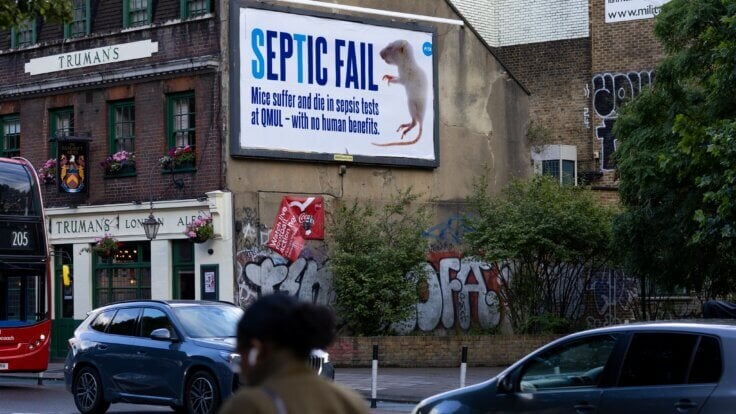
Ahead of undergraduate Open Days at Queen Mary University of London (QMUL) on 12 and 13 June, PETA has placed a new ad just a stone’s throw from the campus, warning prospective students that researchers at the university are tormenting mice in cruel and useless sepsis experiments that consistently fail to lead to effective treatments for humans. The appeal depicts a dead mouse alongside the message, “Septic Fail. Mice Suffer and Die in Sepsis Tests at QMUL – With No Human Benefits.”
Update (3 June 2026): PETA Disrupts QMUL Founder’s Day
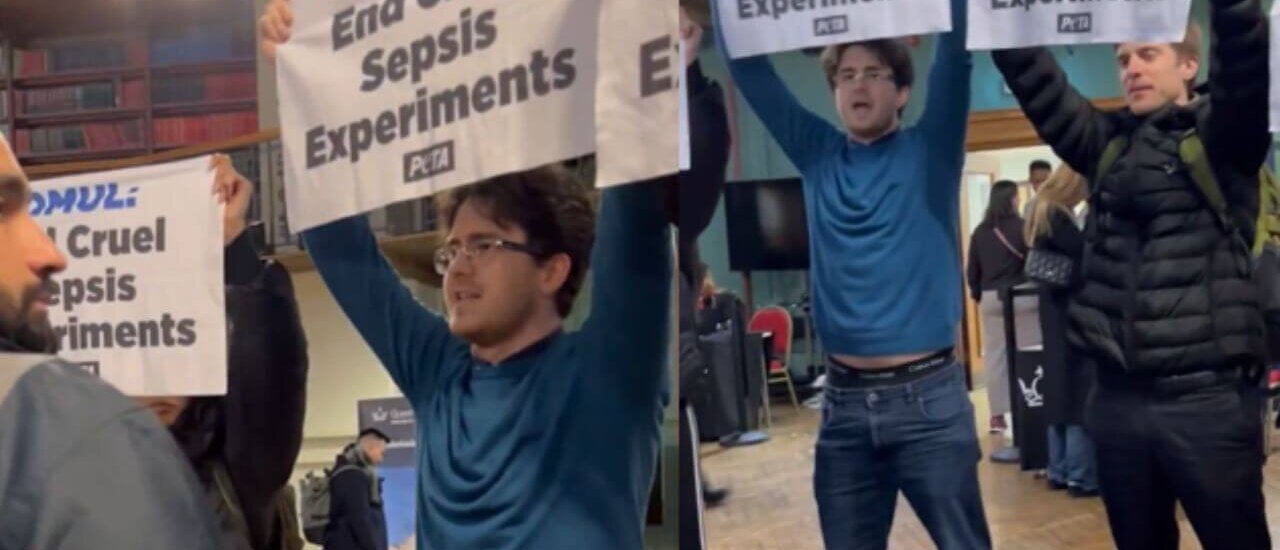
PETA disrupted Queen Mary University of London’s Founder’s Day over cruel sepsis experiments in which mice are cut open, made severely ill, and killed. Holding up a sign reading, “QMUL: End Cruel Sepsis Experiments.” At Queen Mary, mice are forced to endure painful symptoms in these cruel and ineffective experiments before being killed.
Update (7 May 2026): PETA Supporter Disrupts QMUL Event to Expose Cruel Sepsis Experiments
A Queen Mary University of London (QMUL) event, DERI Research Day: AI at QMUL: From Foundations to Societal Impact, was disrupted today by a PETA supporter calling out the university’s cruel sepsis experiments on animals.
Mice are sliced open and have their intestines punctured, causing faeces to leak into their bodies, causing sepsis. Despite the suffering inflicted, these experiments have failed to deliver a single targeted treatment for sepsis in humans.
Update (19 February 2026): PETA Storms QMUL Open Day Event to Demand End to Cruel Sepsis Experiments on Mice
Attendees at the Queen Mary University of London (QMUL) Postgraduate Open Day Event had a more memorable experience than expected today when a group of PETA supporters stormed the famous Octagon inside the Queens’ Building bearing signs that read, “QMUL: End Cruel Sepsis Experiments,” and chanting, “Sepsis experiments should be cruelty free.” The action is part of PETA’s ongoing campaign calling on the university to stop tormenting mice in cruel and useless sepsis experiments, which consistently fail to lead to effective treatments for humans.
Update (11 December 2025): PETA Crashes Queen Mary University of London Senate Meeting Over Cruel Sepsis Experiments on Mice
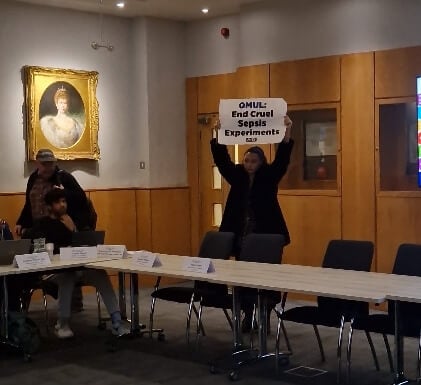
This afternoon, PETA supporters stormed the Senate meeting at Queen Mary University of London (QMUL) with a sign reading “QMUL: End Cruel Sepsis Experiments”, proclaiming, “Mice are not lab equipment! They are thinking, sensitive individuals.” to call on the university to stop torturing mice in cruel and ineffective sepsis experiments.
Sliced Open, Infected, Killed
Experimenters at Queen Mary puncture the colons of mice causing faecal matter to leak into their bellies. This is carried out to deliberately cause sepsis.
At UCL, experimenters intentionally administer bacteria into the abdomens of rodents to induce sepsis.
Sepsis can lead to laboured breathing, fever, chills, and organ failure in rodents. At the end of these experiments, they are killed – discarded like mere waste products.
Sepsis Experiments on Rodents Are Futile
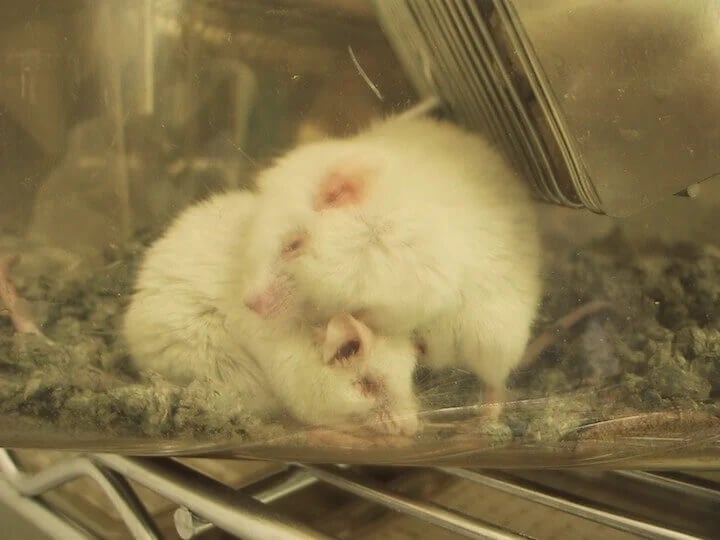
More than 150 drugs have successfully treated sepsis in mice, yet none have succeeded in humans.
This is because sepsis in mice is distinct from sepsis in humans. By experimenting on animals, universities may be hindering the development of effective sepsis treatments, which could be gained from the use of advanced, human-relevant methods.
Francis Collins, the former director of the National Institutes of Health (NIH) in the US, lamented the “heartbreaking loss of decades of research and billions of dollars” spent developing sepsis treatments for mice that failed in humans. In 2025, the NIH launched an initiative to move away from experiments on animals and “prioritise human-based research technologies”.
In addition, the US National Institute of General Medical Studies announced in 2024 and 2025 that it would stop funding experiments that include certain sepsis-induction methods commonly used on rodents, including the caecal ligation and puncture method, which is used at QMUL. It also advocated for non-animal methods in sepsis research.
Mice Are Not Test Subjects
Mice are intelligent, complex, and social individuals with the capacity to experience a wide range of emotions. They become attached to each other, love their families, and easily bond with their human guardians – returning as much affection as is given to them.
UK Universities Must End Cruel Sepsis Experiments
PETA encourages everyone to urge Queen Mary and UCL to take heed of the scientific evidence, and join other institutes – including the University of Kent – that have committed to non-animal methods in sepsis research.
Human-relevant research methods include AI tools, organs-on-chips, and computational models of human cells and organs. The universities have the opportunity to be pioneers in the future of sepsis research by adopting these humane, animal-free methods.
Take Action for Rodents
You can send emails to both Queen Mary and UCL today to urge them to stop subjecting rodents to sepsis experiments.
Contact Queen Mary
Help Animals in 2026: Renew Your PETA Membership!
Donate Now